what does it mean to block a scene
DISCLOSURE: As AN AMAZON Acquaintance I EARN FROM QUALIFYING PURCHASES.
THIS Post MAY Contain Chapter LINKS, MEANING, AT NO Boosted Toll TO YOU, I EARN FROM QUALIFYING PURCHASES. AFFILIATE LINKS ARE MARKED WITH #ad . "I" IN THIS Example Means THE Possessor OF FILMDAFT.COM. Please READ THE FULL DISCLOSURE FOR More INFO.
How is it that films make a conversation between two people feel then dynamic and interesting, even when the characters are stuck in the aforementioned room for the entire scene? It's called blocking.
If yous're in a hurry, hither'south a short definition of the meaning of blocking in movie:
Blocking in film is the placement and movement of actors in relation to the camera–the scene'south choreography. Blocking is used to tell the story by staging the characters' actions to mirror the subtext of what's happening on screen. The movie's director might map out, a.m.a. cake the character'southward deportment in a scene earlier shooting takes place.
You need to block your graphic symbol's actions so that they tin can be lit by the lights and shot by the photographic camera in a fashion that all-time communicates what's happening on screen. One time your scene is blocked, and your bandage and crew accept rehearsed the movements, you lot are ready to shoot!
There's much more to blocking than simply how to exercise it; for example, nosotros'll await at some creative blocking examples to explain and inspire how to use blocking to better tell your story.
Let's dive in!
What is blocking, and why practice y'all need it?
Blocking is when a manager maps out the characters' actions in a scene before they shoot the scene. When a director blocks a scene, you lot are placing the actors and photographic camera coiffure in a way that communicates your vision for how the scene should play out on screen.
Blocking is vital. Without blocking, the actors wouldn't know where to stand, the camera wouldn't know what to focus on, and the audio recorder would get the nail in the shot!
Blocking is also i of the main ways for directors to tell their stories visually. While a writer might write blocking into the script, a director will modify, add their own, or completely invent blocking that fits their own vision for how the characters and the camera move together.
How do yous cake actors?
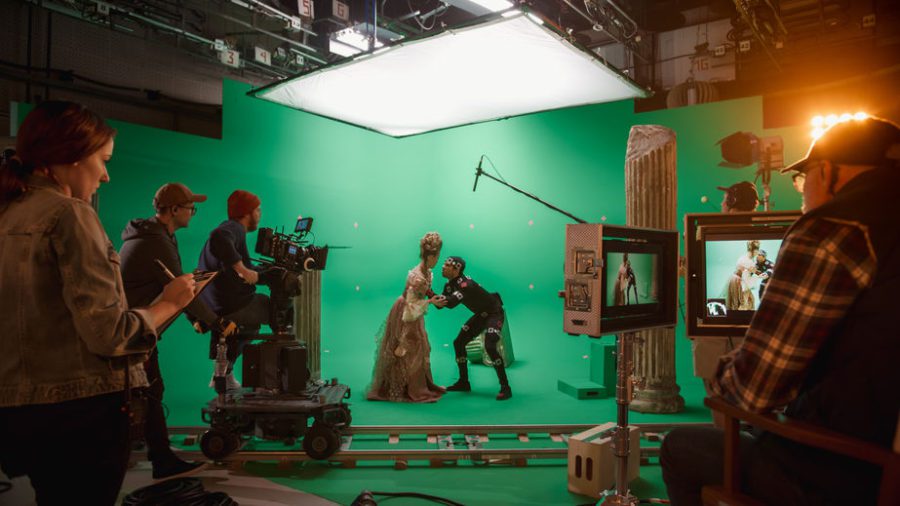
To cake your actors, take the actors walk through the scene'south dialogue and deportment as written. Let them do what comes naturally to them inside the space you are shooting.
A scene may not work the same as written in the actual location you lot are shooting in, so while the actors run through the scene, first or finish to brand adjustments forth the fashion.
Once you lot are satisfied with the actors' concrete placements, mark off their positions so they can return to those same spots at the right time every accept.
If yous are working with big-name talent, you lot might do this process with stand-ins and bring the actors on subsequently you're gear up to shoot.
And then in one case the actors take the scene down, you tin can bring in the camera.
How do you block the camera?

You can cake your camera past placing your camera in a select position to capture the actors co-ordinate to your vision. This often includes camera moves, be it a photographic camera pan, tracking shot, or dolly in or out that y'all need to rehearse with the actors as they move throughout the scene.
After you lot mark off the actor's positioning (as described to a higher place), it's time to bring on the camera crew. Run through the scene with the camera operator, practicing whatsoever photographic camera movements required for the shot.
Remember that blocking and placing the camera isn't just for capturing the action. Where you identify the camera volition convey to the audition what to pay attention to, so block the camera to capture what is most important in the scene.
Lighting after you lot prepare your blocking.
Once both the crew and the bandage know what will happen, work with the DP (Manager of Photography) to low-cal the scene, accounting for any shadows that come with the blocking you merely staged.
You may demand to make adjustments to the blocking depending on your lighting limitations, so be prepared to have a piddling extra fourth dimension before you shoot to rehearse once or twice more than.
This is especially true when lighting for camera moves like a dolly in or tracking shot.
Exercise shot lists help you with blocking?
Yes, having a shot list will definitely assist you throughout the blocking process, only be just as ready to make adjustments to your shot list as you are to make adjustments to your blocking once yous get on set.
You lot'll probably have some new ideas once everything is set. Or yous might run out of time to fit everything y'all planned into the schedule. Either manner, exist set up to improvise!
How do you apply blocking to tell your story visually?
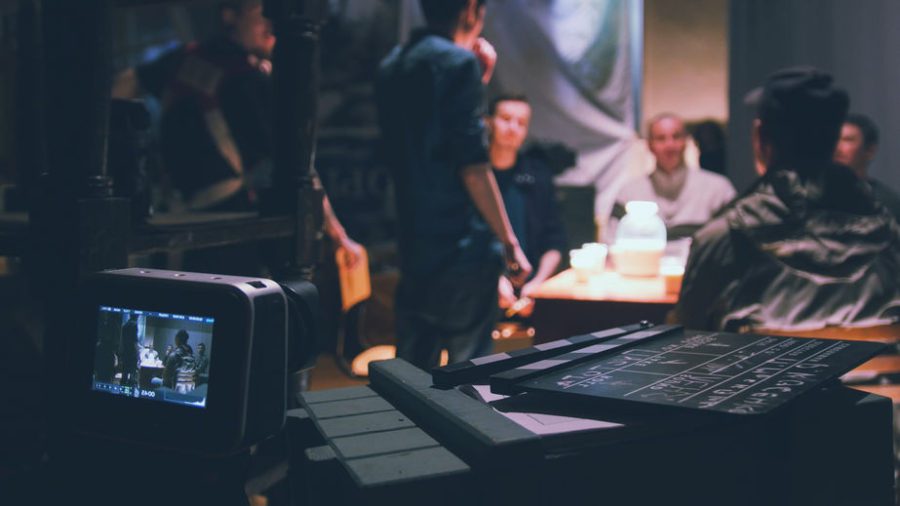
You can utilize blocking to visually tell the story by staging your actors and camera in subtle means that tell their own story about what's happening betwixt the lines.
Skilful directors use blocking to convey data well-nigh each character, how they are feeling, and what their relationship is to the other characters.
As their feelings and relationships change throughout the scene, practiced blocking reflects these subtextual, internal struggles, staging the characters (or photographic camera) to take action.
And so much of human communication is nonverbal, and the aforementioned is true for picture show storytelling. Film is, afterward all, a visual medium.
Examples of famous movies that apply excellent blocking to tell a story.
Hither are a few famous examples of how blocking tells the story between the lines to inspire you to think outside the box.
The Godfather.
Director Francis Ford Copolla's The Godfather is one of those "must watch" films for every aspiring filmmaker due largely to Copolla's mastery of the craft.
There is and so much that is said in every scene without ever being said out loud, as is customary in the picture show'southward not-so-fictional criminal world of the Corleone family, where an assassination can exist ordered with a simple turn of phrase or nod of the head.
Check out this scene from the end of the motion picture, and how Copolla decides to block this moment between the picture's protagonist, Michael Corleone, and his wife, Kay Adams, played past the legendary Al Pacino and Diane Keaton (shared by Youtuber 800mEric):
Lookout how Copolla stages Michael sitting down while he is berated by Connie (played by Talia Shire). When Kay asks him about his business, he gets up and starts pacing. It'south an anxious moment, punctuated past his bestial, "Plenty!" which locks them both in identify.
Kay, meanwhile, keeps her absurd and asks him i more than time if the rumors are true. Michael lies and welcomes her into a hug. Here's where the blocking gets outstanding.
Kay leaves the room while Michael sits on the edge of his desk-bound (showing his power).
Michael, not moving an inch, is so greeted and joined past his fellow mobsters as they swarm around him.
Kay is left to watch from the terminate of the long hallway; so much distance between them.
And then, Michael shuts the door on her, shutting her out from his double life as the newly crowned crime kingpin Don Corleone. Chefs osculation – an ballsy ending for an ballsy film.
Citizen Kane.
Speaking of epic, Orson Welles' Citizen Kane is ane of the most revered cinematic classics in history. If you've ever taken an "Introduction to Film" class, and so y'all definitely know this movie.
Classics like Citizen Kane are classics for a reason, and this masterpiece scene, shared below by Youtuber mort367, is another textbook instance of first-class blocking.
Watch how in the scene, Kane's titular character, played here by Buddy Swan as an eight-year-quondam Kane, is seen playing out in the snowfall through a window while the adults inside decide his fate.
The adults move through the scene as their ability dynamics shift, ultimately leading to the moment they go outside to tell Orson his fate.
Both acting and blocking piece of work together to transform what looks initially like a cruel move past Kane'southward mother to send young Kane abroad into a centre-breaking conclusion of steely resolve to save him from his abusive male parent, punctuated by Welles' option to terminate on a close-upward of her.
If you lot know the film, then you lot know this scene has a double meaning. One of Kane's happiest memories is likewise the moment of inception of the trauma that defined the rest of his life.
Inglourious Basterds.
Nothing is harder to block for visual storytellers than a scene of a few people sitting in a room talking. It's the blight of directors the world over – except for Quentin Tarantino.
In the manager'southward culling history World War 2 classic Inglourious Basterds, Tarantino wrote himself pages and pages of x+ minute scenes of dialogue to shoot. A principal of edifice tension, all the same, Tarantino keeps the audience in suspense the entire time. How?
Blocking, of grade!
Consider the scene in the Nazi-occupied french bar, where a handful of our heroes are secret as nazis when a group of off-duty nazis stumbles upon them on their night off.
Come across in this shot from film-catch.com how the villains are revealed feet kickoff in this excellently blocked introduction?
Introducing the threat in this mode creates an ominous presence from the moment they enter the scene, quite literally honing in on our heroes from higher up and trapping them in a stone room with nowhere to go.
The scene is long – longer than this 14 minute clip provided below past Youtuber HeyItsThe80s – but information technology's a masterclass in how to build tension with blocking. In particular, sentry the clip below – after the nazis start to become suspicious of our heroes and start asking questions.
Pay special attention to how characters move (or don't move) when they are in control of the narrative.
When a character is making their power play and dominating the conversation, they are loose and easy going.
When a character is nervous, and on the edge of their seat, they quite literally freeze up, like in this still of two characters from the moving-picture show, one feigning confidence and the other frozen stiff in fear.
1 of the best parts of the scene is when the power dynamic shifts thanks to a reveal. Tarantino uses the camera to block off a grapheme who has been hiding in plain sight all along, revealing him in this shot at the exact worst moment for our heroes, ratcheting the tension upward even more.
As he makes his introduction, all other characters fall silent and still, leaving united states to wonder if this means the finish for our heroes. Every bit he arrives at the table, he towers over the others. But no worries – they have an answer to his question and win him over.
Simply as information technology seems all is well, i of our heroes, played below past Michael Fassbender, makes a fatal mistake, and, well, you lot'll have to watch the scene to meet how it all plays out.
From the character positioning to the camera placement to the precise editing and cantankerous-cutting, this scene is a cinematic classic and one to surely win yous over to the power of a well-blocked scene of a group of people sitting in a room talking. Boring? Non in the slightest.
National Lampoon's Christmas Holiday.
Lastly, this scene from manager Jeremiah Southward. Chechik and writer John Hughes' Christmas classic National Lampoon's Christmas Vacation is a flick-perfect example of how to use blocking and editing together to capture the comedy and horror of an all too familiar feeling: family gatherings.
Check out the clip shared by Youtuber Jeffbekeris below.
Everything from the initial blocking of the innocent victims – I mean Griswolds – sitting in wait, ears perking up at the sound of the doorbell, to the tedious zoom in on the front door, to the way the in-laws descend on the family-like zombies picking off casualty.
At the same time, the choppy editing cuts from claustrophobic shut-up to claustrophobic close-up, ALL piece of work together to convey the anxiety of hosting family unit for the holidays visually. I've never seen a more than accurate scene in my life.
That'due south all you need to know well-nigh blocking!
That's all folks. I hope you lot found this article helpful? As ever, if y'all have any comments or questions, feel gratuitous to share them in the comment section below.
To check out more than films to watch to learn filmmaking on your own (and not just blocking), check out our listing here.
For more most how to write a film that works (that's worth blocking), check out our article on the subject here.

Grant Harvey is a freelance writer, screenwriter, and filmmaker based out of Los Angeles. When he's not working on his ain feature-length screenplays and television pilots, Grant uses his passion and experience in motion picture and videography to help others learn the tools, strategies, and equipment needed to create high-quality videos every bit a filmmaker of whatsoever skill level.
Source: https://filmdaft.com/what-is-blocking-in-film-and-how-do-you-use-it-to-tell-a-story-with-examples/
0 Response to "what does it mean to block a scene"
Post a Comment