N Commedia Dell arte Troupes Costumes and Masks Were Used to Help the Audience Quickly


Commedia dell'arte Troupe on a Carriage in a Town Foursquare past Jan Miel (1640)
Commedia dell'arte (;[1] [two] Italian: [komˈmɛːdja delˈlarte]; lit. 'one-act of the profession')[iii] was an early on form of professional theatre, originating in Italian republic, that was popular throughout Europe between the 16th and 18th centuries.[4] [5] Information technology was formerly called Italian comedy in English and is also known equally commedia alla maschera , commedia improvviso , and commedia dell'arte all'improvviso .[6] Characterized by masked "types", commedia was responsible for the rise of actresses such as Isabella Andreini[seven] and improvised performances based on sketches or scenarios.[8] [9] A commedia , such as The Molar Puller, is both scripted and improvised.[8] [10] Characters' entrances and exits are scripted. A special feature of commedia is the lazzo , a joke or "something foolish or witty", usually well known to the performers and to some extent a scripted routine.[x] [11] Another characteristic of commedia is pantomime, which is by and large used by the graphic symbol Arlecchino, now better known as Harlequin.[12]
The characters of the commedia unremarkably stand for fixed social types and stock characters, such as foolish former men, devious servants, or armed services officers full of false bravado.[viii] [xiii] The characters are exaggerated "existent characters", such as a know-it-all dr. called Il Dottore, a greedy quondam man called Pantalone, or a perfect relationship like the Innamorati.[7] Many troupes were formed to perform commedia , including I Gelosi (which had actors such as Andreini and her married man Francesco Andreini),[14] Confidenti Troupe, Desioi Troupe, and Fedeli Troupe.[seven] [8] Commedia was often performed outside on platforms or in popular areas such equally a piazza (town square).[6] [8] The form of theatre originated in Italian republic, only travelled throughout Europe and even to Moscow.[fifteen]
The genesis of commedia may be related to funfair in Venice, where the author and thespian Andrea Calmo had created the character Il Magnifico, the precursor to the vecchio (old homo) Pantalone, by 1570. In the Flaminio Scala scenario, for example, Il Magnifico persists and is interchangeable with Pantalone into the 17th century. While Calmo's characters (which also included the Spanish Capitano and a dottore type) were non masked, it is uncertain at what point the characters donned the mask. However, the connexion to funfair (the menstruation between Epiphany and Ash Wed) would suggest that masking was a convention of funfair and was applied at some point. The tradition in Northern Italia is centred in Florence, Mantua, and Venice, where the major companies came nether the protection of the diverse dukes. Concomitantly, a Neapolitan tradition emerged in the south and featured the prominent stage figure Pulcinella, which has been long associated with Naples and derived into diverse types elsewhere—most famously as the puppet character Punch (of the eponymous Punch and Judy shows) in England.
History [edit]

Claude Gillot (1673–1722), Four Commedia dell'arte Figures: 3 Gentlemen and Pierrot, c. 1715
Although commedia dell'arte flourished in Italy during the Mannerist period, there has been a long-standing tradition of trying to establish historical antecedents in antiquity. While it is possible to observe formal similarities between the commedia dell'arte and earlier theatrical traditions, there is no manner to establish certainty of origin.[16] Some engagement the origins to the menstruation of the Roman Republic (Plautine types) or the Empire (Atellan Farces). The Atellan Farces of the Roman Empire featured rough "types" wearing masks with grossly exaggerated features and an improvised plot.[17] Some historians contend that Atellan stock characters, Pappus, Maccus+Buccus, and Manducus, are the primitive versions of the commedia characters Pantalone, Pulcinella, and il Capitano.[eighteen] [19] [20] More recent accounts plant links to the medieval jongleurs, and prototypes from medieval moralities, such every bit Hellequin (as the source of Harlequin, for example).[21]

The first recorded commedia dell'arte performances came from Rome as early as 1551.[22] Commedia dell'arte was performed outdoors in temporary venues by professional actors who were costumed and masked, as opposed to commedia erudita ,[a] which were written comedies, presented indoors by untrained and unmasked actors.[24] This view may be somewhat romanticized since records describe the Gelosi performing Tasso's Aminta, for example, and much was done at courtroom rather than in the street. By the mid-16th century, specific troupes of commedia performers began to coalesce, and by 1568 the Gelosi became a singled-out visitor. In keeping with the tradition of the Italian Academies, I Gelosi adopted as their print (or coat of arms) the two-faced Roman god Janus. Janus symbolized both the comings and goings of this travelling troupe and the dual nature of the actor who impersonates the "other." The Gelosi performed in Northern Italy and France where they received protection and patronage from the King of France. Despite fluctuations the Gelosi maintained stability for performances with the "usual ten": "2 vecchi (old men), 4 innamorati (2 male and two female person lovers), two zanni , a helm and a servetta (serving maid)".[25] Commedia oft performed inside in courtroom theatres or halls, and besides as some fixed theatres such every bit Teatro Baldrucca in Florence. Flaminio Scala, who had been a minor performer in the Gelosi published the scenarios of the commedia dell'arte around the starting time of the 17th century, really in an effort to legitimize the form—and ensure its legacy. These scenarios are highly structured and built around the symmetry of the diverse types in duet: two zanni , vecchi , inamorate and inamorati , etc.
In commedia dell'arte , female roles were played by women, documented as early on as the 1560s, making them the starting time known professional person actresses in Europe since antiquity. Lucrezia Di Siena, whose proper noun is on a contract of actors from 10 October 1564, has been referred to equally the first Italian actress known by proper noun, with Vincenza Armani and Barbara Flaminia as the get-go primadonnas and the kickoff well-documented actresses in Italy (and Europe).[26] In the 1570s, English theatre critics generally denigrated the troupes with their female person actors (some decades later, Ben Jonson referred to one female performer of the commedia as a "tumbling whore"). Past the terminate of the 1570s, Italian prelates attempted to ban female performers; however, past the terminate of the 16th century, actresses were standard on the Italian stage.[27] The Italian scholar Ferdinando Taviani has collated a number of church documents opposing the advent of the actress every bit a kind of courtesan, whose scanty attire and promiscuous lifestyle corrupted young men, or at to the lowest degree infused them with lecherous desires. Taviani's term negativa poetica describes this and other practices offensive to the church, while giving u.s.a. an idea of the phenomenon of the commedia dell'arte performance.

Past the early 17th century, the zanni comedies were moving from pure improvisational street performances to specified and conspicuously delineated acts and characters. Three books written during the 17th century—Cecchini's Fruti della moderne commedia (1628), Niccolò Barbieri's La supplica (1634) and Perrucci'south Dell'arte rapresentativa (1699—"fabricated firm recommendations concerning performing practice." Katritzky argues, that equally a result, commedia was reduced to formulaic and stylized interim; as far equally possible from the purity of the improvisational genesis a century earlier.[28] In France, during the reign of Louis XIV, the Comédie-Italienne created a repertoire and delineated new masks and characters, while deleting some of the Italian precursors, such as Pantalone. French playwrights, specially Molière, gleaned from the plots and masks in creating an indigenous handling. Indeed, Molière shared the stage with the Comédie-Italienne at Petit-Bourbon, and some of his forms, eastward.g. the tirade, are derivative from the commedia ( tirata ).
Commedia dell'arte moved outside the metropolis limits to the théâtre de la foire , or fair theatres, in the early 17th century as information technology evolved toward a more pantomimed style. With the dispatch of the Italian comedians from France in 1697, the form transmogrified in the 18th century equally genres such as comédie larmoyante gained in attraction in French republic, particularly through the plays of Marivaux. Marivaux softened the commedia considerably by bringing in true emotion to the phase. Harlequin achieved more prominence during this period.
Information technology is possible that this kind of improvised acting was passed downwards the Italian generations until the 17th century when information technology was revived as a professional theatrical technique. Yet, as currently used the term commedia dell'arte was coined in the mid-18th century.[29]
Curiously, commedia dell'arte was as if not more than popular in France, where information technology continued its popularity throughout the 17th century (until 1697), and it was in France that commedia developed its established repertoire. Commedia evolved into various configurations beyond Europe, and each country acculturated the class to its liking. For example, pantomime, which flourished in the 18th century, owes its genesis to the grapheme types of the commedia , particularly Harlequin. The Punch and Judy puppet shows, popular to this day in England, owe their basis to the Pulcinella mask that emerged in Neapolitan versions of the form. In Italy, commedia masks and plots plant their manner into the opera buffa , and the plots of Rossini, Verdi, and Puccini.
During the Napoleonic occupation of Italia, instigators of reform and critics of French Regal rule (such as Giacomo Casanova) used the carnival masks to hide their identities while fueling political agendas, challenging social dominion and hurling blatant insults and criticisms at the regime. In 1797, in club to destroy the impromptu style of carnival equally a partisan platform, Napoleon outlawed the commedia dell'arte. Information technology was not reborn in Venice until 1979 because of this.[xxx]
Companies [edit]

Commedia dell'arte troupe I Gelosi in a late 16th-century Flemish painting
Compagnie , or companies, were troupes of actors, each of whom had a specific function or role. Actors were versed in a plethora of skills, with many having joined troupes without a theatre background. Some were doctors, others priests, others soldiers, enticed by the excitement and prevalence of theatre in Italian society. Actors were known to switch from troupe to troupe "on loan," and companies would oftentimes collaborate if unified by a single patron or performing in the same general location.[31] Members would besides splinter off to form their own troupes, such was the instance with the Ganassa and the Gelosi. These compagnie travelled throughout Europe from the early period, commencement with the Soldati, then, the Ganassa, who travelled to Kingdom of spain,[32] and were famous for playing the guitar and singing—never to exist heard from once more—and the famous troupes of the Aureate Age (1580–1605): Gelosi, Confidenti, Accessi. These names which signified daring and enterprise were appropriated from the names of the academies—in a sense, to lend legitimacy. However, each troupe had its impresse (like a glaze of artillery) which symbolized its nature. The Gelosi, for case, used the two-headed confront of the Roman god Janus, to signify its comings and goings and human relationship to the flavour of Funfair, which took place in Jan. Janus as well signified the duality of the actor, who is playing a character or mask, while nonetheless remaining oneself.
Magistrates and clergy were not always receptive to the travelling compagnie (companies), particularly during periods of plague, and because of their afoot nature. Actors, both male person and female person, were known to strip nearly naked, and storylines typically descended into crude situations with overt sexuality, considered to teach nothing only "lewdness and adultery...of both sexes" by the French Parliament.[33] The term vagabondi was used in reference to the comici , and remains a derogatory term to this solar day (vagabond). This was in reference to the nomadic nature of the troupes, oft instigated by persecution from the Church, ceremonious authorities, and rival theatre organisations that forced the companies to move from place to place.
A troupe oft consisted of ten performers of familiar masked and unmasked types, and included women.[25] The companies would employ carpenters, props masters, servants, nurses, and prompters, all of whom would travel with the visitor. They would travel in large carts laden with supplies necessary for their nomadic style of performance, enabling them to move from place to place without having to worry well-nigh the difficulties of relocation. This nomadic nature, though influenced past persecution, was besides largely due in function to the troupes requiring new (and paying) audiences. They would take advantage of public fairs and celebrations, most often in wealthier towns where financial success was more probable. Companies would besides find themselves summoned by high-ranking officials, who would offer patronage in return for performing in their state for a sure corporeality of time. Companies in fact preferred to not stay in any i place as well long, mostly out of a fear of the act becoming "stale." They would movement on to the side by side location while their popularity was still active, ensuring the towns and people were pitiful to see them leave, and would exist more probable to either invite them back or pay to watch performances again should the troupe always render.[34] Prices were dependent on the troupe'southward conclusion, which could vary depending on the wealth of the location, the length of stay, and the regulations governments had in place for dramatic performances.
Listing of known commedia troupes [edit]
- Compagnia dei Fedeli: active 1601–52, with Giambattista Andreini
- Compagnia degli Accesi: active 1590–1628
- Compagnia degli Uniti: active 1578–1640
- Compagnia dei Confidenti: active 1574–99; reformed nether Flaminio Scala, operated once more 1611–39
- I Dedosi: active 1581–99
- I Gelosi: active 1568–1604
- Signora Violante and Her Troupe of Dancers: active 1729–32[35]
- Zan Ganassa: active 1568–1610
[36]
Characters [edit]

Generally, the actors playing were diverse in groundwork in terms of course and religion, and performed anywhere they could. Castagno posits that the artful of exaggeration, baloney, anti-humanism (as in the masked types), and excessive borrowing as opposed to originality was typical of all the arts in the late Italian Renaissance.[37] Theatre historian Martin Green points to the extravagance of emotion during the flow of commedia 's emergence as the reason for representational moods, or characters, that define the art. In commedia , each character embodies a mood: mockery, sadness, gaiety, confusion, and so along.[38]
According to 18th-century London theatre critic Baretti, commedia dell'arte incorporates specific roles and characters that were "originally intended equally a kind of characteristic representative of some detail Italian commune or boondocks." (archetypes)[29] [39] The character'south persona included the specific dialect of the region or town represented. Meaning that on stage, each grapheme was performed in its ain dialect. Characters would often be passed down from generation to generation, and characters married onstage were often married in real life as well, seen almost famously with Francesco and Isabella Andreini. This was believed to make performances more than natural, likewise as strengthening the bonds inside the troupe, who emphasized complete unity betwixt every member. Additionally, each character has a singular costume and mask that is representative of the character's role.[29]

Commedia dell'arte has four stock character groups:[13]
- Zanni : servants, clowns; characters such as Arlecchino (also known as Harlequin), Brighella, Scapino, Pulcinella and Pedrolino[40]
- Vecchi : wealthy old men, masters; characters such equally Pantalone and Il Dottore
- Innamorati : young upper form lovers; who would have names such as Flavio and Isabella
- Il Capitano : self-styled captains, braggarts; can also be La Signora if a female person
Masked characters are ofttimes referred to as "masks" (in Italian: maschere ), which, according to John Rudlin, cannot exist separated from the graphic symbol. In other words, the characteristics of the graphic symbol and the characteristics of the mask are the same.[41] In time however, the word maschere came to refer to all of the characters of the commedia dell'arte whether masked or non. Female characters (including female servants) are most often not masked (female amorose are never masked). The female character in the masters group is called Prima Donna and can be one of the lovers. At that place is also a female person graphic symbol known equally The Courtisane who can also take a servant. Female servants wore bonnets. Their character was played with a malicious wit or gossipy gaiety. The amorosi are often children of a male character in the masters grouping, merely not of any female person character in the masters group, which may represent younger women who have eastward.g. married an erstwhile man, or a high-class courtesan. Female person characters in the masters group, while younger than their male counterparts, are nevertheless older than the amorosi . Some of the amend known commedia dell'arte characters are Pierrot and Pierrette, Pantalone, Gianduja, Il Dottore, Brighella, Il Capitano, Colombina, the innamorati , Pedrolino, Pulcinella, Arlecchino, Sandrone, Scaramuccia (also known equally Scaramouche), La Signora, and Tartaglia.
| Grapheme(due south) | Masks | Status | Costume |
|---|---|---|---|
| Arlecchino | Yep | Retainer (sometimes to two masters) | Colorful tight-fitting jacket and trousers |
| Pulcinella | Yes | Retainer or chief | Baggy, white outfit |
| Il Dottore | Yes | Head of the household | Black scholarly robe |
| Il Capitano/La Signora | Aye | Indigent loner | Military uniform |
| Innamorati | No | High-form hopeless lovers | Nicely dressed on par with the time |
| Pantalone | Yep | Older wealthy man | Nighttime capes and scarlet trousers |
| Tartaglia | Yes | Stuttering statesman | Large felt chapeau and enormous cloak |
| Colombina | Yes | Perky maid / servant | Tin exist colourful on par with Arlecchino or blackness and white |
| Pierrot | Yep | Servant (Sorry clown) | White, flowy costume with large buttons |
In the 17th century as commedia became popular in France, the characters of Pierrot, Columbine and Harlequin were refined and became essentially Parisian, according to Green.[43]
Costumes [edit]
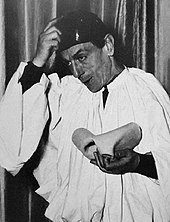
Each character in commedia dell'arte has a distinct costume that helps the audience understand who the character is.
Arlecchino originally wore a tight fitting long jacket with matching trousers that both had numerous odd shaped patches, normally green, yellow, red, and brown.[44] [45] Usually, there was a bat and a wallet that would hang from his belt.[45] His hat, which was a soft cap, was modeled after Charles IX or after Henri Ii, and almost always had a tail of a rabbit, hare or a fob with the occasional tuft of feathers.[45] [44] During the 17th century, the patches turned into blue, scarlet, and light-green triangles arranged in a symmetrical design.[45] The 18th century is when the iconic Arlecchino look with the diamond shaped lozenges took shape. The jacket became shorter and his lid inverse from a soft cap to a double pointed hat.[45]


Il Dottore's costume was a play on the academic dress of the Bolognese scholars.[45] [44] Il Dottore is near always clothed entirely in black.[45] He wore a long black gown or jacket that went beneath the knees.[45] [44] Over the gown, he would accept a long black robe that went downward to his heels, and he would take on black shoes, stockings, and breeches.[45] [44] In 1653, his costume was changed by Augustin Lolli who was a very popular Il Dottore player. He added an enormous black hat, inverse the robe to a jacket cut similarly to Louis Xiv, and added a flat ruff to the neck.[45]
Il Capitano's costume is similar to Il Dottore's in the fact that it is also a satire on military wear of the fourth dimension.[44] This costume would therefore change depending on where the Capitano character is from, and the flow the Capitano is from.[44] [45]
Pantalone has one of the well-nigh iconic costumes of commedia dell'arte . Typically, he would wear a tight-plumbing fixtures jacket with a matching pair of trousers. He usually pairs these two with a big black coat called a zimarra .[45] [44]
Women, who usually played servants or lovers, wore less stylized costumes than the men in commedia . The lovers, Innamorati , would wear what was considered to be the fashion of the time menstruum. They would only article of clothing plainly half-masks with no graphic symbol distinction or street makeup.
Subjects [edit]
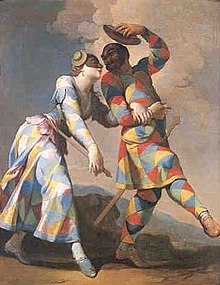
Conventional plot lines were written on themes of sex, jealousy, love, and old age. Many of the basic plot elements can exist traced dorsum to the Roman comedies of Plautus and Terence, some of which were themselves translations of lost Greek comedies of the 4th century BC. Nonetheless, information technology is more probable that the comici used contemporary novella, or, traditional sources as well, and drew from current events and local news of the day. Non all scenari were comic, there were some mixed forms and even tragedies. Shakespeare's The Tempest is drawn from a popular scenario in the Scala collection, his Polonius (Hamlet) is fatigued from Pantalone, and his clowns bear homage to the zanni .
Comici performed written comedies at court. Vocal and dance were widely used, and a number of innamorati were skilled madrigalists, a song form that uses chromatics and shut harmonies. Audiences came to see the performers, with plotlines condign secondary to the operation. Among the great innamorate , Isabella Andreini was perhaps the about widely known, and a medallion defended to her reads "eternal fame". Tristano Martinelli achieved international fame as the first of the neat Arlecchinos, and was honoured by the Medici and the Queen of French republic. Performers fabricated employ of well-rehearsed jokes and stock concrete gags, known as lazzi and concetti , equally well as on-the-spot improvised and interpolated episodes and routines, called burle (singular burla , Italian for 'joke'), ordinarily involving a practical joke.
Since the productions were improvised, dialogue and activeness could easily exist changed to satirize local scandals, current events, or regional tastes, while still using old jokes and punchlines. Characters were identified by costumes, masks, and props, such as a type of baton known every bit a slapstick. These characters included the forebears of the modern clown, namely Harlequin ( Arlecchino ) and the zanni. Harlequin, in particular, was allowed to comment on current events in his entertainment.[46]
The archetype, traditional plot is that the innamorati are in dear and wish to be married, but one elder ( vecchio ) or several elders ( vecchi ) are preventing this from happening, leading the lovers to ask one or more zanni (eccentric servants) for help. Typically the story ends happily, with the marriage of the innamorati and forgiveness for whatsoever wrongdoings. In that location are countless variations on this story, likewise every bit many that diverge wholly from the structure, such as a well-known story almost Arlecchino becoming mysteriously pregnant, or the Punch and Judy scenario.[ citation needed ]
While mostly personally unscripted, the performances often were based on scenarios that gave some semblance of a plot to the largely improvised format. The Flaminio Scala scenarios, published in the early 17th century, are the most widely known collection and representative of its most esteemed compagnia , I Gelosi.
Influence in visual art [edit]

The iconography of the commedia dell'arte represents an unabridged field of study that has been examined by commedia scholars such as Erenstein, Castagno, Katritzky, Molinari, and others. In the early period, representative works by painters at Fontainebleau were notable for their erotic depictions of the thinly veiled innamorata , or the bare-breasted courtesan/actress.
The Flemish influence is widely documented as commedia figures entered the world of the vanitas genre, depicting the dangers of lust, drinking, and the hedonistic lifestyle. Castagno describes the Flemish pittore vago (wandering painters) who alloyed themselves inside Italian workshops and even causeless Italian surnames: ane of the most influential painters, Lodewyk Toeput, for example, became Ludovico Pozzoserrato and was a celebrated painter in the Veneto region of Italy. The pittore vago can be attributed with establishing commedia dell'arte equally a genre of painting that would persist for centuries.
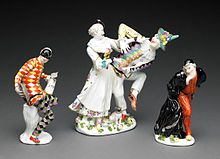
While the iconography gives testify of the performance style (encounter Fossard collection), it is important to annotation that many of the images and engravings were not depictions from real life, but concocted in the studio. The Callot etchings of the Balli di Sfessania (1611) are most widely considered capricci rather than bodily depictions of a commedia dance form, or typical masks. While these are often reproduced in big formats, information technology is important to note that the actual prints measured about 2×three inches. In the 18th century, Watteau's painting of commedia figures intermingling with the elite were often set in sumptuous garden or pastoral settings and were representative of that genre.
Pablo Picasso'due south 1921 painting Three Musicians is a colorful representation of commedia -inspired characters.[47] Picasso also designed the original costumes for Stravinsky's Pulcinella (1920), a ballet depicting commedia characters and situations. Commedia iconography is evident in porcelain figurines many selling for thousands of dollars at auction.
Influence in performance art [edit]

The expressive theatre influenced Molière's one-act and afterward ballet d'action , thus lending a fresh range of expression and choreographic means. An example of a commedia dell'arte graphic symbol in literature is the Pied Piper of Hamelin who is dressed as Harlequin.
Music and dance were central to commedia dell'arte performance, and most performances had both instrumental and vocal music in them.[48] Brighella was frequently depicted with a guitar, and many images of the commedia characteristic singing innamorati or dancing figures. In fact, it was considered role of the innamorati function to be able to sing and have the pop repertoire under their belt. Accounts of the early commedia , as far back as Calmo in the 1570s and the buffoni of Venice, note the ability of comici to sing madrigali precisely and beautifully. The danzatrice probably accompanied the troupes and may have been in add-on to the general cast of characters. For examples of strange instruments of various grotesque formations, run across articles by Tom Heck, who has documented this area.
The works of a number of playwrights take featured characters influenced by the commedia dell'arte and sometimes directly drawn from it. Prominent examples include The Tempest past William Shakespeare, Les Fourberies de Scapin past Molière, Servant of Two Masters (1743) by Carlo Goldoni, the Figaro plays of Pierre Beaumarchais, and specially Love for Three Oranges, Turandot and other fiabe by Carlo Gozzi. Influences appear in the lodgers in Steven Berkoff'southward adaptation of Franz Kafka's The Metamorphosis.

Pierrot as "Pjerrot" in Denmark
Through their association with spoken theatre and playwrights commedia figures have provided opera with many of its stock characters. Mozart's Don Giovanni sets a puppet show story and comic servants like Leporello and Figaro take commedia precedents. Soubrette characters similar Susanna in Le nozze di Figaro, Zerlina in Don Giovanni and Despina in Così fan tutte remember Columbina and related characters. The comic operas of Gaetano Donizetti, such equally Elisir d'amore, depict readily upon commedia stock types. Leoncavallo's tragic melodrama Pagliacci depicts a commedia dell'arte company in which the performers detect their life situations reflecting events they describe on stage. Commedia characters likewise figure in Richard Strauss's opera Ariadne auf Naxos.
The piano piece Carnaval by Robert Schumann was conceived as a kind of masked ball that combined characters from commedia dell'arte with real world characters, such equally Chopin, Paganini, and Clara Schumann, as well every bit characters from the composer'south inner world.[49] [fifty] Movements of the piece reverberate the names of many characters of the Commedia , including Pierrot, Harlequin, Pantalon, and Columbine.
Stock characters and situations as well appear in ballet. Igor Stravinsky'southward Petrushka and Pulcinella insinuate straight to the tradition.
Commedia dell'arte is performed seasonally in Denmark on the Peacock Stage of Tivoli Gardens in Copenhagen, and north of Copenhagen at Dyrehavsbakken.[ citation needed ] Tivoli has regular performances, while Bakken has daily performances for children by Pierrot and a puppet version of Pulcinella resembling Punch and Judy.[ commendation needed ]
The characters created and portrayed by English comedian Sacha Baron Cohen (most famously Ali G, Borat, and Bruno) have been discussed in relation to their potential origins in commedia , equally Baron Cohen was trained past French master clown Philippe Gaulier, whose other students have gone on to become teachers and performers of commedia .[51]
Encounter likewise [edit]
Notes [edit]
- ^ English language literal translation: "learned comedies"[23]
References [edit]
- ^ "commedia dell'arte". Merriam-Webster Dictionary.
- ^ "commedia dell'arte". Lexico UK English Dictionary. Oxford University Press. northward.d.
- ^ Commedia dell'arte at the Encyclopædia Britannica
- ^ Lea, K. M. (1962). Italian Popular Comedy: A Study In The Commedia Dell'Arte, 1560–1620 With Special Reference to the English State. New York: Russell & Russell INC. p. 3.
- ^ Wilson, Matthew R. "A History of Commedia dell'arte". Faction of Fools. Faction of Fools. Retrieved 9 December 2016.
- ^ a b Rudlin, John (1994). Commedia Dell'Arte An Role player's Handbook. London and New York: Routledge. p. 48. ISBN978-0-415-04769-two.
- ^ a b c Ducharte, Pierre Louis (1966). The Italian One-act: The Improvisation Scenarios Lives Attributes Portraits and Masks of the Illustrious Characters of the Commedia dell'Arte. New York: Dover Publication. p. 17. ISBN978-0486216799.
- ^ a b c d e Chaffee, Judith; Crick, Olly (2015). The Routledge Companion to Commedia Dell'Arte. London and New York: Rutledge Taylor and Francis Group. p. one. ISBN978-0-415-74506-2.
- ^ "Faction Of Fools".
- ^ a b Grantham, Barry (2000). Playing Commedia A Preparation Guide to Commedia Techniques. United Kingdom: Heinemann Drama. pp. 3, 6–7. ISBN978-0-325-00346-7.
- ^ Gordon, Mel (1983). Lazzi: The Comic Routine of the Commedia dell'Arte . New York: Performing Arts Journal Publications. p. four. ISBN978-0-933826-69-iv.
- ^ Broadbent, R.J. (1901). A History Of Pantomime. New York: Benjamin Blom, Inc. p. 62.
- ^ a b "Faction of Fools | A History of Commedia dell'Arte". world wide web.factionoffools.org . Retrieved 2016-12-09 .
- ^ Maurice, Sand (1915). The History of the Harlequinade. New York: Benjamin Bloom, Inc. p. 135.
- ^ Nicoll, Allardyce (1963). The Earth of Harlequin: A Critical Study of the Commedia dell'Arte. London: Cambridge Academy Press. p. 9.
- ^ Castagno 1994, p. 94.
- ^ Smith 1964, p. 26, quote: "Atellanae were forced marked by improvisations and masked personages...
- ^ Duchartre, Pierre (1966). The Italian Comedy. New York: Dover Publications, INC. p. 29.
Pulcinella was e'er dressed in white like Maccus, the mimus albus, or white mime.
- ^ Duchartre, Pierre (1966). The Italian Comedy. New York: Dover Publication, INC. p. 18.
Side by side there is the ogre Manducus, the Miles Glorious in the plays of Plautus, who is later metamorphosed into the swaggering Captain, of Helm.
- ^ Duchartre, Pierre (1966). The Italian One-act. New York: Dover Publications, INC. p. 18.
...Bucco and the sensual Maccus, whose lean figure and cowardly nature reappear in Pulcinella.
- ^ Palleschi 2005, Part 1.
- ^ Katritzky 2006, p. 82.
- ^ Cohen & Sherman 2020, p. 192
- ^ Rudlin p. 14
- ^ a b Rudlin & Crick 2001, p. 15
- ^ Giacomo Oreglia (2002). Commedia dell'arte. Ordfront. ISBN 91-7324-602-6
- ^ Katritzky 2006, p. 90.
- ^ Katritzky 2006, p. 106.
- ^ a b c Katritzky 2006, p. 19
- ^ "Carnival in Venice".
- ^ Ducharte, Pierre Louis (1966). The Italian Comedy. Toronto: General Publishing Visitor. p. seventy.
- ^ Kenley, M. E. (2012-11-01). "Il Mattaccino: music and dance of the matachin and its part in Italian one-act". Early Music. forty (4): 659–670. doi:ten.1093/em/cas089. ISSN 0306-1078.
- ^ Ducharte, Pierre Louis (1966). The Italian Comedy. Toronto: Full general Publishing Company. p. 74.
- ^ Ducharte, Pierre Louis (1966). The Italian One-act. Toronto: Full general Publishing Company. p. 79.
- ^ McArdle, Grainne (2005). "Signora Violante and Her Troupe of Dancers 1729-32". Eighteenth-Century Ireland / Iris an Dá Chultúr. 20: 55–78. doi:x.3828/eci.2005.8. JSTOR 30071051.
- ^ Ducharte, Pierre Louis (1966). The Italian Comedy. Toronto: Full general Publishing. pp. 86–98.
- ^ Castagno 1994, p.[ folio needed ].
- ^ Greenish & Swan 1993, pp. xi–xii.
- ^ Oreglia, Giacomo (1968). The Commedia dell'Arte. Hill & Wang. pp. 65, 71. OCLC 939808594.
- ^ Rudlin, An Role player's Handbook. p. 67.
- ^ Rudlin, An Thespian'due south Handbook. p. 34.
- ^ "Commedia Stock Characters". shane-arts.com. Archived from the original on 2005-02-07. Retrieved 2016-04-05 .
- ^ Green & Swan 1993, p. 163.
- ^ a b c d e f g h Rudlin, John (1994). Commedia dell'Arte An Thespian'southward Handbook. New York: Routledge. pp. 67–156. ISBN978-0-415-04769-2.
- ^ a b c d due east f chiliad h i j k l Ducharte, Pierre (1966). The Italian Comedy. New York: Dover. pp. 164–207.
- ^ Oreglia, Giacomo (1968). The Commedia dell'Arte. Colina & Wang. p. 58. OCLC 939808594.
- ^ Katritzky 2006, p. 26.
- ^ Cohen & Sherman 2020, p. 233
- ^ https://calperformances.org/acquire/program_notes/2011/pn_gerstein.pdf[ bare URL PDF ]
- ^ "Carnaval, Op. ix".
- ^ Sacha Baron Cohen: How To Prank The Establishment. YouTube. Archived from the original on 2021-12-11.
Sources [edit]
- Castagno, Paul C. (1994). The Early on Commedia dell'arte (1550–1621): The Mannerist Context. Bern, New York: Peter Lang Publishing.
- Cohen, Robert; Sherman, Donovan (2020). Theatre: Brief Edition (Twelfth ed.). New York, NY. ISBN978-i-260-05738-6. OCLC 1073038874.
- Dark-green, Martin; Swan, John (1993). The Triumph of Pierrot: The Commedia dell'arte and the Modernistic Imagination. Pennsylvania State Academy. ISBN978-0-271-00928-5.
- Katritzky, M. A. (2006). The Fine art of Commedia: A Study in the Commedia dell'arte 1560–1620 with Special Reference to the Visual Records. New York: Editions Rodopi. ISBN978-90-420-1798-half-dozen.
- Palleschi, Marino (2005). "The Commedia dell'arte: Its Origins, Development & Influence on the Ballet". Auguste Vestris.
- Rudlin, John. Commedia dell'arte: An Player's Handbook. Ebook Corporation.
- Rudlin, John; Crick, Oliver (2001). Commedia dell'arte: A Handbook for Troupes. London: Routledge. ISBN041-520-408-nine.
- Smith, Winifred (1964). The Commedia dell'arte. Benjamin Blossom.
Further reading [edit]
- Aguirre, Mariano 'Qué es la Commedia dell'arte' (Castilian) [1]
- Chaffee, Judith; Crick, Oliver, eds. (2014). The Routledge Companion to Commedia Dell'Arte. Routledge. ISBN978-i-317-61337-4.
- Callery, Dymphna. Through the Body: A Practical Guide to Physical Theatre. London: Nickalis Hernt Books (2001). ISBN 1-85459-630-half dozen
- Cecchini, Pier Maria (1628) Frutti delle moderne comedie et avvisi a chi le recita, Padua: Guareschi
- Perrucci, Andrea (1699) Dell'arte rappresentativa premeditata, ed all'improviso
- Scala, Flaminio (1611) Il Teatro Delle Favole Rappresentative (online pdf bachelor at Bavarian Country Library website). Translated into English by Henry F. Salerno in 1967 as Scenarios of the Commedia dell'arte. New Italian edition cured by F.Mariotti (1976). New partial translation (30 scenarios out of 50) past Richard Andrews (2008) The Commedia dell'arte of Flaminio Scala, A Translation and Assay of Scenarios Published by: Scarecrow Printing.
- Darius, Adam. The Commedia dell'arte (1996) Kolesnik Production OY, Helsinki. ISBN 952-90-7188-4
- DelPiano, Roberto La Commedia dell'arte 2007. Retrieved 2009-07-09.
- Grantham, Barry Playing Commedia, Nick Hern Books, London, 2000. ISBN 978-1-85459-466-2
- Grantham, Barry Commedia Plays: Scenarios – Scripts – Lazzi, Nick Hern Books, London, 2006. ISBN 978-1-85459-871-4
- Jordan, Peter (2013). The Venetian Origins of the Commedia Dell'Arte. Routledge. ISBN978-one-136-48824-5.
- Katritzky, K A (2019). "Stefanelo Botara and Zan Ganassa: Textual and Visual Records of a Musical commedia dell'arte Duo, In and Beyond Early Modern Iberia". Music in Art: International Journal for Music Iconography. 44 (one–2): 97–118. ISSN 1522-7464.
- Puppa, Paolo A History of Italian Theatre. Eds. Joseph Farrell. Cambridge University Press. 2006. ISBN 0-521-80265-2
- Sand, Maurice (1860). Masques et bouffouns:(comédie italienne) (in French). Illustrated by Maurice Sand. Paris: Michel Levy Freres. Retrieved 22 October 2013.
- Smith, Winifred (1912). The Commedia dell'Arte: A Written report in Popular Italian Comedy. New York: The Columbia University Press. Retrieved July x, 2009.
john rudlin commedia dell'arte.
- Taviani, Ferdinando and Marotti, Ferruccio, and Romei, Giovanna. La Commedia dell'arte e la societa barocca M. Bulzoni, Roma : 1969
- Taviani, Ferdinando and Chiliad. Schino (1982) Il segreto della commedia dell'arte.
- Tessari, R. (1969) La commedia dell'arte nel seicento
- Tessari, R. (1981) Commedia dell'arte: la maschera e fifty'ombra
- Tony, Kishawi Teaching Commedia dell'arte (2010) A pace by footstep handbook for the theatre ensemble and Drama teacher. [ii] ISBN 978-0-646-53217-2
- Just Masquerade – types of masks used
External links [edit]
- commedia-dell-arte.com – Judith Chaffee's Commedia website, with resources, annotated bibliography, and links
- Meagher, Jennifer (2007) Commedia dell'arte, Metropolitan Museum of Art, July 2007
- Bellinger, Martha Fletcher (2002) "The Commedia dell'arte", A Short History of the Drama (1927)
- Wilson, Matthew R. (2010) A History of Commedia dell'Arte
Source: https://en.wikipedia.org/wiki/Commedia_dell%27arte
0 Response to "N Commedia Dell arte Troupes Costumes and Masks Were Used to Help the Audience Quickly"
Post a Comment